
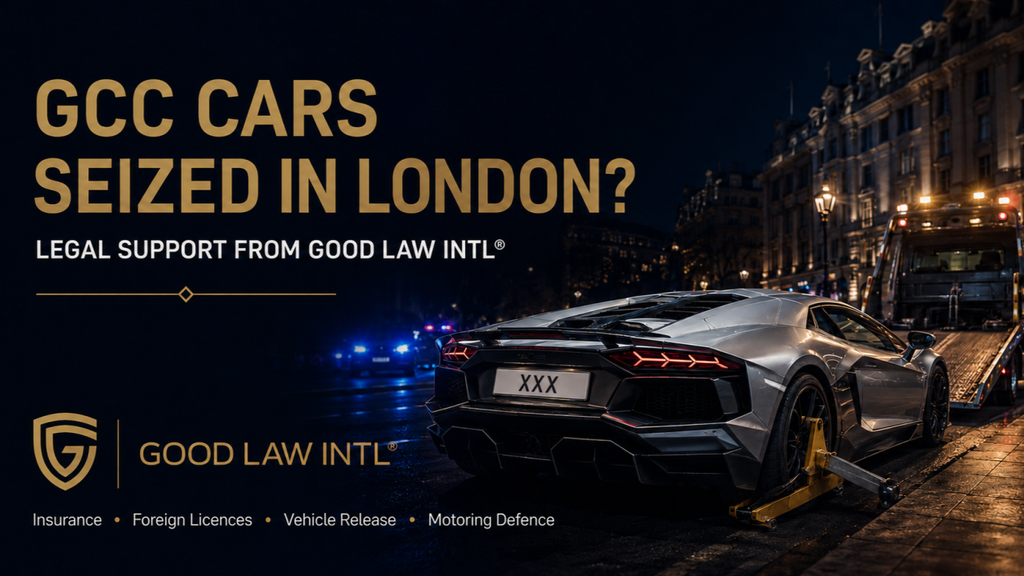
GCC-Owned Supercars Seized in London: What International Visitors Need to Know, By Atef Elmarakby – GOOD LAW INTL®
Every summer, London welcomes thousands of visitors from Saudi Arabia, the United Arab Emirates, Qatar, Kuwait, Bahrain, Libya, Oman and the wider Middle East. I have not seen one from Egypt personally just yet. J
Many bring their own luxury and performance cars to use during their stay. Many use their preferred vehicle to travel back and forth between the UK, Belgium, France and the Netherlands.
However, an increasing number of foreign-registered vehicles are being stopped, seized and impounded by the London Metropolitan Police. The principal reasons include:
- alleged lack of valid UK motor insurance;
- driving without a licence recognised in Great Britain;
- failure to produce an International Driving Permit or English translation;
- unnecessary engine revving and excessive noise;
- careless, dangerous or antisocial driving;
- vehicle modifications that may not comply with UK law; and
- failure to comply with temporary-importation requirements.
In August 2026, the Metropolitan Police announced that it had seized 90 vehicles worth more than £9 million during a three-day operation targeting uninsured, dangerous and antisocial driving in Hyde Park, Kensington and Chelsea.
Some of the cars had reportedly been in the UK for only a very short period before being seized. This demonstrates an important point: foreign registration, overseas insurance and ownership of the vehicle do not automatically establish that the car can lawfully be driven in the United Kingdom.
For GCC visitors, the consequences can be serious. In addition to losing possession of a valuable vehicle, the driver may face prosecution, penalty points, a substantial fine, disqualification from driving in Great Britain and, in more serious cases, arrest or criminal proceedings.
1. Does GCC motor insurance cover driving in London?
Every vehicle used on a road or other public place in Great Britain must have insurance satisfying the minimum requirements of the Road Traffic Act 1988.
A driver may hold comprehensive insurance in Saudi Arabia, the UAE, Qatar, Kuwait, Bahrain or Oman but still not be legally insured to drive in Britain.
The policy must be examined carefully to confirm that:
- Great Britain falls within its territorial coverage;
- the particular driver is insured;
- the particular vehicle is covered;
- the purpose for which the car is being used is permitted;
- the policy provides at least the third-party cover required under UK law;
- the insurer is authorised or otherwise able to provide recognised cover;
- the vehicle’s foreign registration has been properly disclosed;
- all modifications have been declared; and
- the insurance remains valid during the entire UK visit.
Shipping insurance, travel insurance, public liability insurance or a general international insurance card may not be sufficient. The police may also want to verify the cover directly with the insurer.
An overseas certificate written only in Arabic may be difficult to verify at the roadside unless it is accompanied by an official English translation and clear confirmation from the insurer.
Driving without insurance is generally a strict liability offence. This means that an honest belief that the vehicle was insured will not necessarily provide a complete defence.
The police may issue a fixed penalty of £300 and six penalty points. If the case proceeds to court, the driver may receive:
- an unlimited fine;
- between six and eight penalty points;
- disqualification from driving in the UK; and
- an order requiring payment of prosecution costs and a victim surcharge.
The police may also seize the vehicle under section 165A of the Road Traffic Act 1988.
2. Can a GCC national drive in Britain using a GCC licence?
A visitor may normally be able to drive in Great Britain using a valid foreign driving licence, subject to the applicable conditions and time limits. However, the precise position depends on:
- the country that issued the licence;
- whether it is a full or provisional licence;
- the driver’s age;
- the category of vehicle covered;
- whether the driver is genuinely a visitor or has become resident in Britain;
- the driver’s date of arrival;
- whether the licence remains valid in its issuing country; and
- whether an International Driving Permit or official translation is required.
A common problem arises where a person possesses a GCC driving licence but cannot immediately prove what categories it covers, whether it is full or provisional, or whether it remains valid.
When seeking the release of a vehicle from a Metropolitan Police pound, a person holding a non-EU/EEA driving licence will normally be expected to produce:
- the original foreign driving licence;
- an International Driving Permit or official English translation;
- a passport or other recognised photographic identification;
- evidence of immigration status; and
- evidence showing the date of arrival in the United Kingdom.
An International Driving Permit does not replace the original licence. It operates alongside it. The driver should therefore carry both documents.
Driving without the correct entitlement, or otherwise than in accordance with a licence, can result in:
- a fine of up to £1,000;
- three to six penalty points;
- possible disqualification; and
- seizure of the vehicle.
Foreign motorists should not assume that penalty points or a driving ban cannot affect them because they do not hold a British licence. The UK authorities can create a driving record for a foreign driver, and a British court can disqualify that person from driving in Great Britain.
3. Can the police seize a car for revving its engine?
Revving an engine is not automatically a criminal offence in every situation. The legal problem arises when the conduct causes—or is likely to cause—alarm, distress or annoyance to members of the public, particularly when combined with careless or inconsiderate driving.
Conduct likely to attract police attention includes:
- repeatedly revving a high-powered engine;
- rapid acceleration in a residential or crowded area;
- using launch control on a public road;
- wheel spinning or causing tyre noise;
- racing or appearing to race another vehicle;
- driving in a noisy convoy;
- unnecessary use of the horn;
- obstructing traffic while people photograph or film the car;
- driving with an excessively noisy or modified exhaust; and
- gathering with other vehicles in a way that causes disturbance.
Section 59 of the Police Reform Act 2002 gives the police powers in relation to vehicles used in a manner that is careless, inconsiderate or otherwise unlawful and is causing, or is likely to cause, alarm, distress or annoyance to members of the public.
The law has recently been strengthened so that, in relevant circumstances, officers can seize vehicles involved in antisocial conduct without first providing the warning that was traditionally required.
This is particularly important in areas such as Knightsbridge, South Kensington, Mayfair, Hyde Park and Chelsea, where residents frequently complain about engine noise, racing and late-night gatherings involving performance cars.
Depending on the circumstances, the driver may also be investigated for:
- careless or inconsiderate driving;
- dangerous driving;
- speeding;
- racing on a public road;
- driving without proper control;
- excessive vehicle noise;
- using a vehicle in a dangerous condition; or
- breaching vehicle construction and use requirements.
4. Temporary importation of GCC-registered vehicles
A non-UK resident visiting Great Britain may usually use a foreign-registered vehicle without registering or taxing it in the UK if:
- the person is visiting and does not intend to live in Britain;
- the vehicle is registered and taxed in its home country;
- it is used for no more than six months in total during a 12-month period;
- it is imported for the visitor’s private use;
- it is not sold, lent or hired to another person in the UK; and
- it is re-exported within the permitted period.
The six months may consist of one continuous visit or several shorter visits during a 12-month period.
Visitors should retain documentary evidence showing:
- when the vehicle entered the country;
- how it was transported;
- who owns it;
- its foreign registration and taxation status;
- the owner’s normal residence outside the UK;
- the temporary-admission arrangements;
- any HMRC declarations or relief; and
- the planned date of re-export.
If stopped, the driver may be required to establish why the vehicle can lawfully be used without UK registration and taxation.
Additional problems can arise where:
- the vehicle remains in Britain for longer than permitted;
- the owner has become UK-resident;
- a friend or relative drives the vehicle;
- the car is lent, rented or sold;
- temporary customs admission was not properly claimed;
- the registration plates cannot be read or identified in Britain; or
- the car is used for commercial rather than private purposes.
Where the characters displayed on foreign number plates are not identifiable in the UK—for example, where the plate uses only Arabic script—temporary Q number plates may be required.
A breach may lead not only to police action but also to potential DVLA, HMRC, VAT, customs-duty and vehicle-registration consequences.
5. Vehicle modifications and UK roadworthiness requirements
A vehicle that is legal to drive in a GCC country is not necessarily legal to drive on a British road.
The police may inspect:
- exhaust modifications;
- exhaust valves and noise-control devices;
- tinted windows;
- number plates;
- tyres;
- lights and indicators;
- emissions equipment;
- suspension and body modifications;
- vehicle safety and roadworthiness; and
- performance modifications that have not been disclosed to the insurer.
Performance cars fitted with modified exhaust systems are particularly vulnerable to enforcement action. A modification may also invalidate the insurance if it was not properly disclosed.
Even where the immediate reason for the police stop is excessive noise, the inspection may reveal separate insurance, licensing, registration or roadworthiness offences.
6. What happens after the police seize the vehicle?
Where a vehicle is seized because the officer believes that the driver was uninsured or was not driving in accordance with a valid licence, the driver should normally receive a seizure notice.
The owner or registered keeper must act immediately.
The Metropolitan Police ordinarily requires the owner or keeper to attend the correct police pound within seven days of the date stated on the notice. Failure to act may eventually result in the vehicle being disposed of.
To recover the vehicle, the owner will ordinarily need to provide:
- valid photographic identification;
- proof of ownership or registered-keeper status;
- the original registration documentation;
- proof of address;
- a valid driving licence;
- an International Driving Permit or official translation, where applicable;
- passport and immigration documentation;
- evidence of the date of entry into Britain;
- a valid certificate of motor insurance; and
- payment of removal and storage charges.
The insurance must permit the vehicle to be released from a government impound. Some temporary or short-term policies expressly exclude impounded vehicles.
If the insurance was purchased after the seizure, all material facts must be disclosed to the new insurer, including the seizure, the alleged offence and any pending prosecution. Failure to disclose accurate information can invalidate the new policy and may create further legal problems. The owner is normally required to attend in person. Exceptions may be available where the owner is:
- outside the country;
- in hospital;
- in custody;
- unable to attend because of injury or disability; or
- prevented by compelling medical or compassionate circumstances.
If the owner cannot lawfully drive the car from the pound, it may be necessary to nominate a properly licensed and insured driver or arrange for an insured specialist recovery operator.
7. Should the owner refuse to pay if the seizure is disputed?
Usually, no. A challenge to the lawfulness of the seizure does not automatically suspend storage charges or prevent disposal of the vehicle. The sensible approach will normally be to:
- recover the vehicle as quickly as possible;
- pay the applicable removal and storage charges;
- state that the charges are paid under protest where appropriate;
- preserve all documents and evidence; and
- pursue the complaint, defence or legal challenge separately.
Leaving a valuable car in the pound while arguing with the police can result in rapidly increasing charges and, eventually, disposal of the vehicle.
8. Can the seizure or prosecution be challenged?
Yes, but the appropriate remedy depends on why the vehicle was seized and whether criminal proceedings have also been commenced. A legal challenge may involve:
- representations to the Metropolitan Police;
- a formal complaint concerning an unlawful seizure;
- challenging a fixed penalty;
- entering a not-guilty plea in the Magistrates’ Court;
- obtaining the officer’s statement and body-worn video;
- securing CCTV, dashcam or mobile-phone footage;
- obtaining ANPR and roadside records;
- securing written confirmation from the foreign or UK insurer;
- proving that the driver held a valid and recognised licence;
- obtaining certified translations of GCC documents;
- challenging whether the conditions for a section 59 seizure existed;
- obtaining expert evidence about the exhaust or vehicle noise;
- presenting mitigation to reduce a fine or avoid disqualification;
- advancing a special-reasons argument where legally available;
- appealing from the Magistrates’ Court to the Crown Court; or
- in exceptional cases, considering judicial review.
The criminal allegation and the seizure of the vehicle may involve separate procedures. Even if the driver is not ultimately convicted, reimbursement of the removal and storage charges may need to be pursued independently.
9. Are there immigration consequences?
A minor motoring offence will not normally result in the automatic cancellation of a visitor’s visa. However, immigration implications may arise where the case involves:
- dangerous driving;
- repeated offending;
- driving while disqualified;
- an accident causing death or serious injury;
- arrest or imprisonment;
- false documents;
- dishonesty toward the police or an insurer;
- failure to pay a court fine; or
- failure to disclose a material conviction in a future immigration application.
A British driving ban applies to the individual’s ability to drive in Great Britain, even if the person retains a valid licence in their home country.
Visitors should also consider the reputational consequences of police action involving a distinctive or valuable vehicle. High-profile enforcement operations may attract press and social-media attention.
10. How GOOD LAW INTL® can assist
GOOD LAW INTL® is a UK-based international law firm with Arabic-speaking lawyers and experience assisting overseas individuals, families and businesses.
We can provide urgent assistance where a GCC-owned vehicle has been stopped, seized or impounded in London. Our services may include:
Emergency vehicle-release assistance
- reviewing the police seizure notice;
- identifying the statutory basis of the seizure;
- liaising with the police and relevant vehicle pound;
- reviewing GCC and UK insurance documents;
- contacting insurers and insurance brokers;
- checking the driver’s licence and UK entitlement;
- arranging official Arabic-to-English translations;
- preparing the vehicle-release documentation;
- advising on attendance at the police pound;
- arranging an authorised driver or recovery operator; and
- protecting the vehicle from unnecessary storage charges or disposal.
Police investigation and court representation
- advice before a police interview;
- attendance at a voluntary interview or police station;
- representations to the police;
- defence of insurance and licence allegations;
- section 59 antisocial-driving cases;
- careless or dangerous-driving allegations;
- excessive-noise and vehicle-modification cases;
- Magistrates’ Court representation;
- mitigation, special reasons and disqualification arguments; and
- advice on appeals and public-law remedies.
Where required, we can work with specialist road-traffic barristers, automotive engineers, acoustic experts and insurance professionals.
Pre-arrival compliance service
The safest solution is to obtain advice before the vehicle is shipped to the UK. GOOD LAW INTL® can review:
- the visitor’s immigration and residence status;
- the foreign driving licence;
- the need for an International Driving Permit;
- UK-recognised insurance;
- vehicle ownership documentation;
- authority for another person to drive;
- HMRC temporary admission;
- customs and shipping documentation;
- number-plate compliance;
- vehicle modifications and exhaust systems;
- the permitted period of use; and
- the documents that should remain in the vehicle.
This preventative review can substantially reduce the risk of the car being stopped or seized after arrival.
Before driving your GCC-registered car in London
Visitors should carry:
- their passport;
- their original full driving licence;
- an International Driving Permit or official translation;
- proof of their UK entry date;
- the original vehicle registration document;
- evidence of ownership;
- temporary-import and shipping documents;
- the full motor-insurance certificate;
- direct insurer contact details; and
- evidence that any relevant modifications have been disclosed and accepted.
Drivers should also avoid unnecessary engine revving, rapid acceleration, racing, obstructing traffic, noisy gatherings and any use of the car likely to cause alarm or disturbance.
Urgent legal assistance
If your vehicle has been seized, do not delay. Storage charges can increase daily, and the police may eventually dispose of an unclaimed vehicle. Contact GOOD LAW INTL® immediately and provide:
- the seizure notice;
- your passport;
- your driving licence;
- your International Driving Permit;
- your insurance certificate;
- the vehicle registration documents;
- evidence of ownership;
- shipping and customs records; and
- any video or photographic evidence of the police stop.
Our Arabic-speaking legal team can assess the position, coordinate the release process and advise on any police investigation or court proceedings.
GOOD LAW INTL® — UK legal support for international motorists, GCC families and overseas vehicle owners.
This article provides general information about the law in England and Wales as at August 2026. It does not constitute legal advice. Each case depends on its particular facts, documentation and the statutory power used by the police.
#GOODLAWINTL #GCC #SaudiArabia #UAE #Qatar #Kuwait #Bahrain #Oman #London #Supercars #MotoringLaw #RoadTrafficLaw #VehicleSeizure #InternationalLaw #ArabicLawyers #UKLaw


