
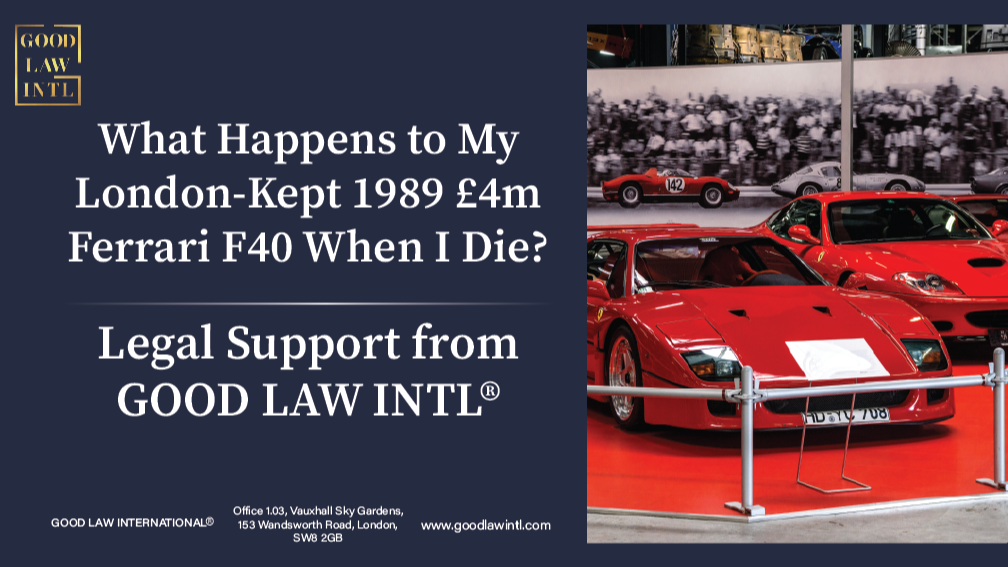
What Happens to My London-Kept 1989 £4m Ferrari F40 When I Die?, a client asks? By Atef Elmarakby | GOOD LAW INTL®
Imagine this.
You are an international entrepreneur or investor. You own homes, investments and businesses across several countries. Among your assets is something rather more interesting: a 1989 Ferrari F40, worth approximately £4 million, which is stored securely in London.
Perhaps you bought it many years ago for a fraction of its present value. Perhaps it forms part of a wider collection. Perhaps you rarely drive it and regard it primarily as an investment.
The question is deceptively simple:
What happens to the Ferrari when you die?
More specifically, could HM Revenue & Customs regard a £4 million Ferrari sitting in a London garage as part of your estate for UK Inheritance Tax purposes?
The answer requires an understanding of a surprisingly important area of UK estate planning: chattels.
A Ferrari is still an asset
People commonly associate UK Inheritance Tax (“IHT”) with houses, bank accounts, investment portfolios and company shares.
But IHT is considerably wider.
HMRC describes Inheritance Tax as a tax on the “property, money and possessions” of a person who has died. The starting point is therefore not whether an asset looks like a conventional investment. The question is whether it constitutes property within the relevant estate.
A Ferrari does.
Indeed, HMRC’s own inheritance tax paperwork specifically asks personal representatives to disclose vehicles.
Form IHT407 – Household and Personal Goods contains a section headed “Vehicles, boats and aircraft”. HMRC specifically requires details of:
“cars, including vintage and classic”
and asks for the manufacturer, model, year, registration number, condition, mileage and — crucially — the open market value at the date of death.
That makes the starting position very clear.
The fact that your Ferrari is a movable personal possession rather than land, shares or cash does not take it outside the inheritance tax regime.
The Ferrari is a “chattel”
In legal and tax terminology, cars fall within the broad category of tangible movable property, commonly referred to as chattels.
HMRC’s own guidance on the pre-owned assets rules expressly describes household and personal goods capable of being moved as “chattels” and gives cars, boats and jewellery as examples.
This category can encompass a very wide range of valuable assets:
- cars and classic cars;
- paintings and works of art;
- jewellery and watches;
- antiques;
- furniture;
- wine collections;
- boats and yachts; and
- other valuable collectibles.
So, from an estate-planning perspective, a Ferrari F40 is not fundamentally different merely because it has four wheels.
At £4 million, it may actually be one of the most significant assets in the estate.
HMRC specifically recognises vintage motor cars for IHT purposes
This is not simply an extrapolation from general inheritance tax principles.
HMRC’s Inheritance Tax Manual IHTM09715 specifically discusses:
“Collections of art, vintage motor cars or wine…”
when explaining how assets within an estate should be valued.
HMRC therefore expressly contemplates vintage and collectible motor cars forming part of an estate subject to IHT valuation.
For an F40 owner, this is significant.
A £4 million Ferrari cannot simply be described in the probate papers as “one old car”.
HMRC expects an appropriate open-market valuation.
How would HMRC value the Ferrari?
The central valuation principle for IHT is the open market value at the date of death.
For an exceptionally valuable Ferrari, determining that value can itself become a material exercise.
The value may depend upon matters including:
- provenance;
- mileage;
- condition;
- originality;
- service history;
- restoration history;
- accident history;
- specification;
- matching components;
- factory certification;
- rarity;
- ownership history;
- significant previous owners;
- concours history; and
- conditions in the international collector-car market at the valuation date.
A £4 million valuation should therefore ordinarily be supported by a suitably qualified specialist rather than an online advertisement for another F40.
HMRC’s IHT407 itself expressly provides for a professional valuation to be submitted.
HMRC also tells its officers examining IHT407 returns to ensure that unsold personal goods are “realistically valued”, with particular attention paid to higher-value items and estates.
For a £4 million Ferrari, one should therefore anticipate scrutiny of the valuation.
What if I bought the Ferrari for only £500,000?
For IHT, the historic purchase price is not the principal question.
Suppose you bought the F40 for £500,000 many years ago.
At your death, a specialist values it at £4 million.
For IHT purposes, the relevant figure is potentially £4 million, not £500,000.
That follows the general IHT principle of valuing property at its open-market value at the relevant time.
This is particularly important with collectible cars because appreciation can be dramatic.
An owner may think of the Ferrari as “the car I bought for £500,000”.
HMRC may be looking at a £4 million estate asset.
But aren’t private cars exempt from Capital Gains Tax?
This is where a particularly important distinction arises.
Capital Gains Tax and Inheritance Tax are different taxes with different rules.
HMRC confirms that ordinary passenger cars are generally exempt from CGT under section 263 of the Taxation of Chargeable Gains Act 1992.
HMRC’s Capital Gains Manual goes further and states that this exemption includes vintage cars of the relevant type.
HMRC’s 2026 guidance on personal possessions similarly states that private cars are exempt from CGT.
Therefore, subject to the precise facts, an individual might own a Ferrari that has appreciated enormously without facing the normal CGT treatment that might apply to another investment asset when it is sold.
But that does not mean that the Ferrari is exempt from IHT.
This is the crucial distinction:
CGT exemption ≠ IHT exemption.
The car can be exempt from CGT on disposal while simultaneously representing a substantial asset within the owner’s estate for IHT purposes.
What could the IHT exposure look like?
Take a deliberately simplified example.
Assume an unmarried individual dies owning:
- a Ferrari F40 worth £4 million; and
- no other assets or liabilities.
Assume further that there are no special exemptions or reliefs available and the ordinary £325,000 nil-rate band is fully available.
For the 2026/27 tax year, the standard IHT rate on estates is 40%, while the ordinary nil-rate band is £325,000.
A simplified calculation would therefore be:
Ferrari value: £4,000,000
Less nil-rate band: £325,000
Potential taxable amount: £3,675,000
40% IHT: £1,470,000
That is an illustrative calculation only. A real estate calculation could be very different depending upon the deceased’s other assets, liabilities, lifetime gifts, marital status, Will, residence history, applicable reliefs and exemptions.
But it illustrates the central issue.
A £4 million car can create a seven-figure inheritance tax exposure.
Does the Residence Nil-Rate Band help with the Ferrari?
Not directly.
The residence nil-rate band is fundamentally connected with a qualifying residence passing to direct descendants. It is not an additional general allowance that can simply be allocated against a Ferrari.
There is another practical problem in a very wealthy estate.
The residence nil-rate band is tapered where the net estate exceeds £2 million, reducing by £1 for every £2 above that threshold.
An individual owning a £4 million Ferrari alongside substantial property, investments and business interests may therefore find that the residence nil-rate band has been substantially reduced or eliminated.
What if I leave the Ferrari to my spouse?
This can change the position dramatically.
Transfers between spouses or civil partners are generally subject to the spouse exemption, although cross-border circumstances require particular care.
HMRC confirms that there is normally no IHT where the estate above the threshold is left to a spouse or civil partner.
So if the Ferrari passes outright to a qualifying spouse, the immediate IHT treatment may be very different from leaving it directly to a child.
However, that does not necessarily eliminate the tax issue permanently.
It may simply move the Ferrari into the surviving spouse’s estate.
If the surviving spouse later dies owning the Ferrari, its value at that later date may then become relevant to the surviving spouse’s IHT position.
This is why succession planning should normally consider both deaths, rather than treating the spouse exemption as the end of the analysis.
What if I simply give the Ferrari to my son or daughter now?
This is where lifetime estate planning becomes interesting.
An outright lifetime gift from one individual to another will generally constitute a potentially exempt transfer, or PET, subject to the detailed statutory conditions.
The basic concept is the familiar seven-year rule.
HMRC confirms that most outright lifetime gifts become exempt if the donor survives for seven years following the gift.
Suppose therefore that the owner gives the £4 million Ferrari outright to an adult daughter.
If the transfer is effective, the daughter genuinely assumes ownership and enjoyment of the car, and the donor survives seven years, the value transferred could potentially fall outside the donor’s estate for IHT purposes.
But there is a very important trap.
“I gave it to my son — but I still drive it.”
That sentence should immediately raise a gift with reservation of benefit issue.
The tax system does not generally allow a person to give away an asset legally, continue enjoying it substantially as before, survive seven years and then claim that the asset has disappeared from the IHT estate.
The gift-with-reservation (“GWR”) provisions are specifically designed to prevent that result.
HMRC explains that the rules exist to prevent individuals reducing their IHT estates through gifts while effectively leaving their practical position unchanged.
Suppose therefore that you transfer legal title to the Ferrari to your son.
But:
you retain the keys;
the Ferrari remains in your London garage;
you continue insuring it;
you decide when it is driven;
you take it to events;
and you continue using it whenever you wish.
Calling your son the “owner” does not necessarily solve the IHT problem.
If there is a reservation of benefit at death, HMRC explains that the gifted property is treated as property to which the donor was beneficially entitled immediately before death and is therefore brought back into the death estate, subject to the applicable rules.
In other words:
giving away the registration document is not necessarily the same thing as giving away the car for IHT purposes.
What if I pay to use the Ferrari after giving it away?
Potentially different.
HMRC’s guidance specifically addresses land and chattels.
HMRC states that a donor’s possession, occupation or enjoyment of gifted chattels is not treated as a reservation where it is for full consideration in money or money’s worth.
But this is not simply a matter of transferring £1 per year to your son and calling it rent.
HMRC says relevant factors include evidence of:
- an arm’s-length bargain;
- independently advised parties; and
- normal commercial criteria.
For a £4 million Ferrari, establishing genuine commercial consideration for continued use would require careful thought and documentation.
Insurance, storage, maintenance, servicing, risk, mileage and the commercial value of access to an exceptionally rare vehicle could all become relevant.
What about pre-owned assets?
There is another anti-avoidance regime that should not be overlooked.
HMRC confirms that an Income Tax charge can potentially arise where someone gives assets away during their lifetime but subsequently continues benefiting from them in certain circumstances.
The pre-owned assets rules expressly contemplate movable chattels including cars, boats and jewellery.
This is another reason why sophisticated estate planning should not begin with:
“Just put the Ferrari in somebody else’s name.”
The legal ownership, beneficial ownership, actual use and tax consequences all need to be considered together.
What if I transfer the Ferrari into a trust?
This is substantially more complicated.
An outright gift to another individual and a transfer into a discretionary trust are not treated identically for IHT.
A transfer into a relevant property trust can potentially constitute an immediately chargeable lifetime transfer, rather than a PET.
Depending on the value transferred, available nil-rate band, previous transfers and the precise structure, an immediate lifetime IHT charge may arise.
There may then also be the separate relevant property regime, including potential ten-year anniversary charges and exit charges.
Accordingly, putting a £4 million Ferrari into a trust is not automatically an IHT solution.
It may simply replace one tax analysis with another.
Trust planning can nevertheless be extremely useful where the objective extends beyond tax — for example:
- preserving a family collection;
- controlling succession;
- preventing fragmentation of ownership;
- protecting an asset for future generations;
- establishing governance around use and disposal; or
- integrating the vehicle into wider family wealth planning.
But the structure must be analysed before the transfer occurs.
What if the Ferrari is owned by my company?
Again, the analysis changes.
If a company owns the Ferrari, the deceased does not personally own the Ferrari itself. Instead, the individual may own shares in the company that owns the Ferrari.
The IHT valuation exercise may therefore concern the shares.
But that does not mean that placing a Ferrari into a company magically removes its value from the estate.
The value of the vehicle may feed directly into the value of the company and therefore into the value of the shareholder’s interest.
There can also be corporate tax, benefit-in-kind, extraction, CGT and other consequences depending upon how the company acquired and uses the car.
Whether any Business Property Relief is available would require a separate and careful examination of the company’s business, activities and asset profile. A valuable investment or personal-use asset sitting inside a company should never simply be assumed to qualify for relief.
What if I am not British?
Nationality is not the determining factor.
This is especially important for internationally mobile families.
The UK IHT regime underwent major changes from 6 April 2025, moving away from the historic domicile-based framework towards a residence-based system for determining the scope of IHT on foreign property.
Accordingly, the analysis for an internationally mobile Ferrari owner may require consideration of matters including:
- UK residence history;
- whether the individual is a long-term UK resident for IHT purposes;
- the location or situs of the asset;
- the timing of any acquisition or gift;
- the individual’s residence position at the relevant time;
- trusts and historic settlements;
- applicable double-taxation arrangements; and
- succession and tax exposure in another jurisdiction.
The answer cannot safely be determined simply by asking:
“What passport do you hold?”
But my Ferrari is physically in London
That fact may be highly significant.
A tangible movable asset physically located in England presents a very different planning issue from money sitting in an overseas bank account.
For international clients, the physical location of valuable chattels should therefore form part of the estate-planning review.
This can include:
cars stored in London;
art hanging in a Mayfair apartment;
jewellery held in a London safe;
a classic-car collection stored in the UK;
or other valuable collectibles physically situated here.
For someone whose principal life and wealth are otherwise outside the UK, it can be surprisingly easy to overlook substantial UK-located personal assets.
Can I move the Ferrari abroad before I die?
Physically moving the Ferrari is one thing.
Changing the IHT analysis is another.
For internationally mobile individuals, changing the situs of tangible movable property may be relevant, but the result cannot be determined in isolation.
Since the post-April 2025 regime can expose foreign assets of a long-term UK resident to UK IHT, merely transporting the Ferrari from London to Monaco, Dubai, Geneva or another jurisdiction does not necessarily remove the asset from UK IHT.
HMRC’s current guidance confirms, for example, that where a donor is long-term UK resident, foreign property subject to the gift-with-reservation rules may remain within the UK IHT charge.
The owner’s residence history and the precise timing therefore matter.
International estate planning must consider the owner and the asset together.
Could the executors simply sell the Ferrari?
Potentially, yes.
That may become necessary if the estate does not contain sufficient liquid assets to meet its tax liabilities and other obligations.
And this illustrates a wider problem with high-value chattels:
they may be extremely valuable but highly illiquid.
A person could die “worth” £10 million while leaving relatively little cash.
For example:
London property: £5 million
Ferrari F40: £4 million
Art and watches: £750,000
Cash: £250,000
Total gross assets: £10 million.
That estate may have considerable value but relatively limited liquidity.
The executors may therefore face difficult decisions about how to fund tax, liabilities and administration expenses.
A forced or poorly timed sale of a rare car may also produce a materially different result from a carefully marketed specialist auction or private sale.
Liquidity planning is therefore an important part of estate planning for collectors.
Could I leave the Ferrari itself to a particular beneficiary?
Yes.
A properly drafted Will can contain a specific legacy of the vehicle.
For example, rather than directing the executors simply to sell all personal possessions, the Will could provide for the Ferrari to pass to a specified child, family member or other beneficiary.
But that raises further questions.
Who bears the IHT attributable to the Ferrari?
Does the beneficiary receive it free of tax?
Does the residue of the estate bear the tax?
What happens if the Ferrari is sold before death?
What happens if it is replaced by another vehicle?
What happens if two children both expect to inherit it?
Who receives associated documentation, spare parts, certificates and memorabilia?
Should the car be held rather than sold?
These are drafting issues, not merely tax issues.
With an asset worth £4 million, they deserve deliberate treatment in the Will.
The documentation may itself be extremely valuable
With collectible cars, the “asset” may extend practically beyond the chassis sitting in the garage.
Original documentation, factory records, books, tools, spare components, correspondence, photographs, racing history, restoration records and provenance documentation may materially affect marketability and value.
The executors need to know where these materials are.
A sophisticated estate plan should therefore maintain an asset record identifying:
- the precise vehicle;
- chassis/VIN;
- registration;
- storage location;
- insurer;
- specialist garage;
- keys;
- security arrangements;
- ownership documents;
- valuation;
- provenance;
- service records; and
- the intended beneficiary.
This is particularly important where family members may know that “Dad has a Ferrari somewhere in London” but have no idea where it is stored or who manages it.
The wider lesson: do not forget the assets that are not on a bank statement
High-net-worth estate planning naturally concentrates on the largest conventional asset classes:
property;
business interests;
shares;
investment portfolios;
pensions;
trusts;
and cash.
But significant wealth can sit elsewhere.
A £4 million Ferrari is wealth.
A £2 million painting is wealth.
A £500,000 watch collection is wealth.
A £1 million wine collection is wealth.
From an IHT perspective, the fact that an asset is enjoyable, collectible, movable or sitting in a garage rather than an investment account does not make its value disappear.
Indeed, HMRC specifically recognises collections of art, vintage motor cars and wine within its inheritance-tax valuation guidance.
So what happens to my £4 million Ferrari when I die?
The short answer is:
someone needs to inherit it — and HMRC may need to know exactly what it was worth.
If you own the Ferrari personally at death and it falls within the scope of UK IHT, its open-market value may form part of your taxable estate.
If it is worth £4 million, that is potentially a very substantial addition to the estate.
If you give it away during your lifetime, the seven-year PET rules may become relevant.
If you give it away but continue enjoying it, the gift-with-reservation rules may bring it back into your estate.
If you transfer it into trust, an entirely different IHT regime may apply.
If a company owns it, the value may instead be reflected in the shares.
If you move it abroad, your residence history and the post-2025 IHT rules must still be considered.
And if you simply leave the issue untouched, your executors may eventually have to solve the tax, valuation, succession and liquidity problems after your death.
The Ferrari test
There is a useful question for anyone undertaking serious estate planning:
If I died tomorrow, would my executors know every significant asset I own, where it is, what it is worth, who should receive it and how the resulting tax is going to be funded?
For many internationally mobile families, the answer is not as straightforward as expected.
The Ferrari F40 is simply a dramatic illustration of the point.
Good estate planning should identify not only your houses, businesses and bank accounts, but also the valuable personal assets accumulated during your lifetime.
Because, as far as HMRC is concerned, the £4 million Ferrari parked quietly in your London garage has not disappeared.
It is still property.
And potentially, it is £4 million of your estate.
How GOOD LAW INTL® can assist
GOOD LAW INTL® advises UK and international individuals and families on estate and succession planning involving UK assets and cross-border wealth.
Where an estate includes valuable cars, art, jewellery or other chattels, the planning exercise may include reviewing:
- UK IHT exposure;
- residence and cross-border considerations;
- lifetime gifting;
- gifts with reservation of benefit;
- trusts and family succession structures;
- Wills and specific legacies;
- ownership through companies or other structures;
- valuation and record-keeping;
- estate liquidity; and
- coordination with tax advisers, valuers and advisers in other jurisdictions.
For internationally mobile individuals in particular, valuable UK-located personal assets should be considered as part of the wider succession plan rather than in isolation.
Disclaimer: This article provides general information only and does not constitute legal, tax or investment advice. UK inheritance tax treatment depends heavily on individual circumstances, residence history, ownership structure, previous gifts, applicable exemptions and reliefs, and the law in force at the relevant time. Professional legal and tax advice should be obtained before undertaking any estate-planning transaction. AI may have assisted.


